
Do I dare to take a 'victory lap'?

INTRODUCTION
Is it time for me to take a ‘victory lap’, to give everyone reading this Substack a big “I told you so!”, even at the risk of seeming to preen and quote myself shamelessly, and probably make myself an intolerable pedantic bore…
This ‘lap impulse’ started yesterday morning when I happened to walk in on Sondra watching Jake Sullivan being interviewed on CNN, regarding his views about the ongoing story of the impending hostage release by Hamas. Sullivan, who served as Biden’s National Security Advisor, did what I expected him to do; he justified his prior policies of holding Israel back from its war on Hamas and putting pressure on Netanyahu to scale back Israel’s war demands. However, he also did something, while not impossible, seemed rather unlikely to me, which was to praise President Donald Trump for being the ‘agent’ responsible for recent events in Gaza — stopping the war and bringing home *all* the Israel hostages.
Parenthetically, I might contrast Sullivan with an email I saw from Ilan Goldenberg, Chief of Policy at J Street, an organization largely composed of Democratic liberal Jews with positive feelings for Israel, but balanced by a concern for the suffering of Gaza which they saw as damaging Israel’s reputation in the world. They not only supported Sullivan’s policies but probably urged him to come down harder on Netanyahu and his democratically elected government. One paragraph followed another. Goldenberg also penned a paragraph almost sounding like contrition, although it was preceded by one of dishonesty.
Given his standing in Israel, Trump could have done this months ago. Allowing Netanyahu to blow up the ceasefire and cut off aid was inexcusable.
Could President Biden have done more? Those of us who served in his administration must grapple with that honestly.
Of course, I expected Sullivan (and Goldenberg) to defend their prior policies. Watching Sullivan, I had no expectation that he would backtrack from any of his prior beliefs; he is ‘human’ after all, no different than anyone else, me and you included. We all hold tight to our beliefs, and although (hopefully) we do not consider them as set in concrete, like Hamas’s ideologies, we tend to defend them in all circumstances.
No, what made me happy was to see Sullivan give credit to Trump. Even if that credit was measured, even if he seemed to sort of squirm in his chair giving that credit, he was at least being ‘realistic’. It gladdened me to think that people we place in positions of power in government are sane, and do not try to deny what is real and palpable. (Besides, any ‘full-throated’ praise for Trump was not called for in any case — we’re talking ‘Trump’, remember. It would be suspicious if the praise was full throated, even if deserved. Who's got a gun to Sullivan’s head, or what’s being offered to him? That’s just the way our society now operates.)
The final trigger for this ‘victory lap’ impulse came yesterday afternoon, when I happened to be switching channels and saw BBC streaming Prime Minister Keir Starmer disembarking down a jetway ramp in Cairo. All these together prompted me to take another look at the Substack that I posted on March 7, 2025, seven months ago. At the time, I was experimenting with linking what I wrote on Substack with what I was writing on Twitter (or X.com), the social media company purchased by Elon Musk.
WHAT I DID IN MARCH
Back then, in March, I wrote a post called “Looking Back From 2084, An Optimistic History”. It was my attempt to predict the future via a literary device of having a character (in the future) write what happened in 2025, as ‘remembered’ in 2084. If you opened my Substack on March 7, and clicked the link, you were taken to my Twitter/X post, which is shown below (in part).
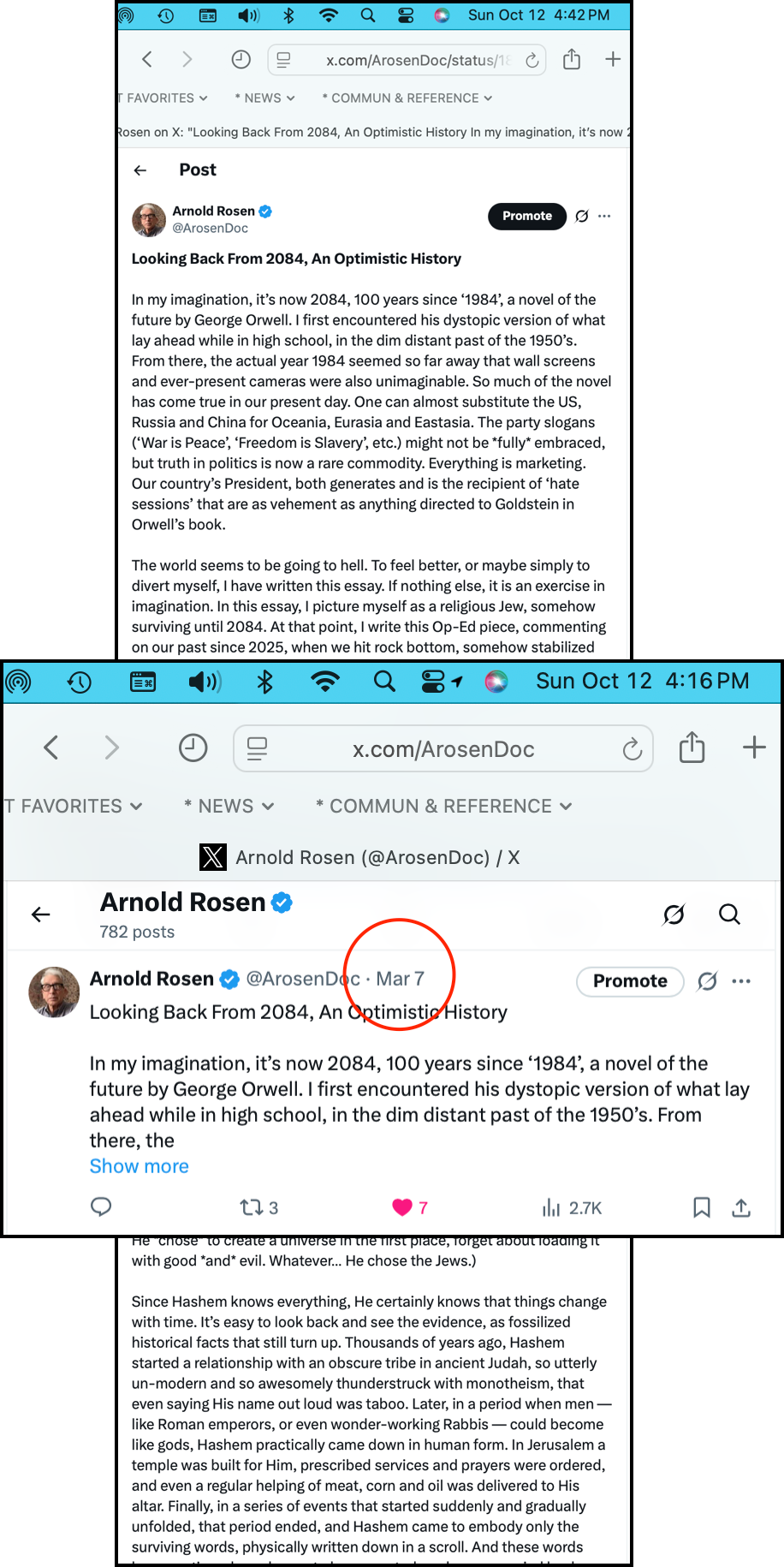
I ‘promoted’ this Twitter/X post, (paying something like 10 or 20 dollars), and instead of only a dozen Twitter people having the ‘opportunity’ to see it, it went into the ‘feed’ of 2700 people. No one from this large cohort made a comment, but 3 people passed it on to others (like ‘forwarding’ in email parlance) and 6 people liked it enough to give it a heart. (I was the 7th, so it shouldn’t count.) Are you following me? The link is still active today, so click on it if you want to see exactly what I’m talking about.
You should keep in mind that the 2084 writer was not only a ‘religious Jew’, somewhat like myself, but also was the type of religious Jew who fully expected to see the hand of G-d, and the workings of miracles, in everything — alas, something I am not about, but maybe trying to work toward? You should also consider where we were then, in the timeline of Gaza; Israel had taken out Nasrallah the year before, the pagers had gone off, Hezbollah was on its back foot and Assad’s regime in Syria had crumbled almost overnight. But the war was already a year and a half old and seemed poised to go on endlessly. Israel had weathered two missile strikes from Iran and seemingly had done little in retaliation. The ‘12 Day War’, concluding with Americas releasing bunker busting bombs out of B2 bombers over Iran was still more than 3 months in the future.
WHAT DID SUBSTACK TELL ME BACK THEN ON HOW MY SUBSTACK WAS RECEIVED… (This Is Kind Of A Primer On How Social Media And The Internet ‘Tracks’ Us. It’s Benign, So Don’t Get Paranoid)
Back in March, Substack provided me with the results from my Substack post and they really weren’t bad. I had 112 ‘subscribers’, and they received my Substack post in email (with the Twitter/X link).
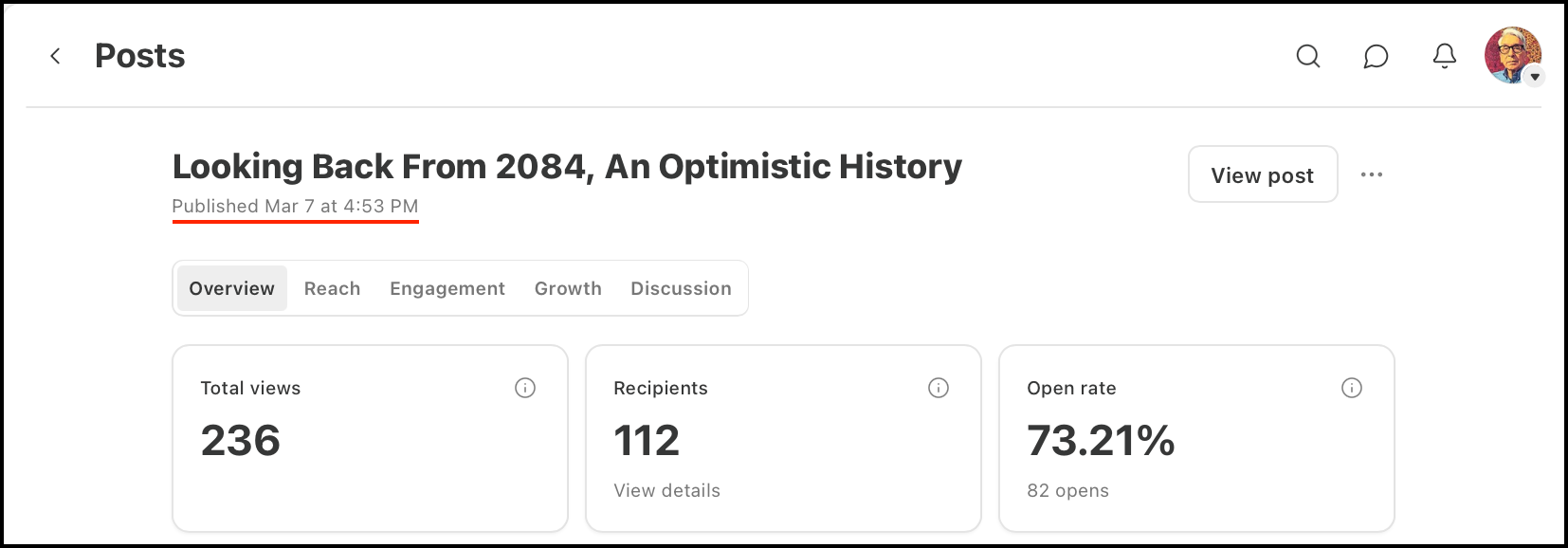
Of those 112, 82 opened the link at least once, and altogether, those 73.21% who opened the Substack email, accounted for 236 viewings. This may be ‘too much information’, but it has a purpose, as this ‘feedback’ from Substack is provided to me every time I post. I do not know how ‘each’ of you, out there in Substack ‘subscriberland’, behaves when you get my Substack email, whether you delete it immediately or go back, day after day, to read and reread portions, and perhaps even think about it. However, I ‘know’ your response in the aggregate. I get, essentially, a ‘bell-shaped’ curve of your ‘engagement’ with my Substack. When I run the responses through a spread sheet it comes out like below.
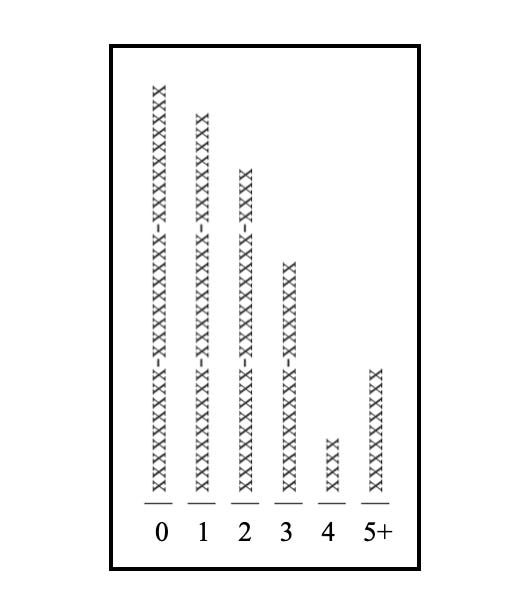
The bar graph above shows the number of times that different subscribers (each represented by an ‘X’) opened the “Looking Back” Substack. About a quarter, (i.e., the zero’s), skipped it entirely; another quarter opened it once — maybe they read it; or maybe they read enough to feel they weren’t interested and then deleted it. I have no way of knowing.
What the graph does tell me, however, is that approximately half of my subscribers opened it on one occasion, and went back to open it subsequently again. I can be certain that people were ‘engaged’ by my fantasy from 2084, and a quarter of the 112 subscribers, by going back to read it 3 or more times, were obviously ‘highly’ engaged. Keep that in mind about social media, and by extension our world wide internet as well. The internet gives a kind of instant feedback; like radar, you can see planes as blips on the screen, and whether they are approaching or not; you just can’t say anything about the individual passengers onboard.
I’ll want to say more about this phenomenon in the future, because it’s important. This tiny indication of connectedness through the internet has never existed before, and it has a larger meaning. If nothing else, it means we are moving into a ‘new age’; an age of super connectivity, worldwide. Humanity has never seen anything like this before. If nothing else, it means there’s a new sheriff in town, and bullshit can no longer fly unimpeded anymore.
I write this on Monday morning, after all the living hostages have been brought back to Israel. All the cable news channels, including BBC *and* Qatar’s Al Jazeera, (but not Iran’s PressTV) are streaming live Netanyahu’s and Trump’s speeches from Jerusalem’s Knesset. I remember my high school history and Woodrow Wilson’s Fourteen Points at the end of the First World War. Specifically, his first point called for “open covenants of peace, openly arrived at,” and advocated for a transparent diplomacy. How much have events in Gaza been covered by ‘streaming’ (Internet) and ‘social media’ (Internet again). Were we not witnesses to a more or less open Gaza negotiation, through a more or less open internet?
For the present, I’ll leave the topic of how the internet will impact our world; how it operates and comes into play. I’m sure I’ll be coming back to it.
WHAT I PREDICTED AND WHAT HAS TRANSPIRED
“Looking Back From 2084, An Optimistic History” was imaginary, but it was based on how I saw the world through my own particular lens, how I saw the forces of the world in operation and what they foretold. I have always used Substack to berate our pundits: Thomas Friedman, Aaron David Miller, along with practically anyone writing for the New York Times. My complaint was consistent — I ‘fah-hocked’ them continuously — you are ignoring the impact of culture, as streamed through Hamas’s mind-set. Even Bret Stephens, who I idolize, came in for criticism from my vantage point as ‘psychiatrist, software developer, with an interest in neurocognition’ for neglecting in his columns this preeminent force shaping the world.
When I wrote my piece last March, Trump had been in office less than 2 months and it wasn’t clear whether he would turn the page from Biden’s lukewarm support of Israel in Gaza. I was trying to be optimistic, and wrote it as a science fiction fantasy, a futuristic memoir from a religious Jew thinking about the miraculous events occurring back in 2025. In one sense, it was pure ‘wishcasting’, an expression of what I ‘wanted’ to happen; but in another sense, it was written out of mind and thought principles I always espoused, in conformity with my Twitter/X ‘profile’, “a retired psychiatrist and software designer, delves into the intersections of brain science, computing, and aging through reflective Substack essays shared on X. His recent writings apply psychiatric frameworks to dissect geopolitical tensions, especially the Israel-Hamas dynamics… emphasizing technology’s role in fostering rational global progress.”
I was already seeing the Internet as something unique, the beginnings of a planet wide neural network, connecting people in ways never before dreamed. I mentioned that Jews as a group were little different from other groups, except they tended to score as ‘smarter’ on intelligence tests. I tried to couch my arguments in a statistic sense, asking that we use average values to make general judgements, avoiding giving excessive weights to outliers and particular personalities.
I remember my captain in the Navy, introducing me in the submarine’s wardroom, filled with other officers, by saying it was good to have a smart Jewish doctor on board. Jews have always been seen ‘smart’, or ‘devious and sly’ (if you disliked them), or the devil-incarnate if you happened to hate them. (If the latter was the case, the hatred was impervious to argument or reason. It existed with a kind of delusional psychotic intensity.)
Halfway through the article I began to describe my vision of how the future will unfold. I noted that Trump had just come into office. No one knew what to expect; there was concern about his sudden policy shifts, his tariffs and other zig zag actions that threatened to sink the economy.
My old irascible Jew from 2084 spoke like Mel Brooks’ 2000 year old man.
Trump may not be smart but he’s not crazy. He knew he was going to have to do something dramatic to turn things around, and restore confidence in his leadership. He knew he would have to pivot and very soon. Did he decide, or did an invisible presence make use of him, (see Jews, see creation?) Whatever. He made use of Israel (and the Jews), and through them, created an ‘off ramp’ from his domestic troubles.” (new italics)
I mentioned how Trump had threatened Hamas with a ‘release the hostages or else’ ultimatum. He threatened to turn Bibi loose, backing Israel so strongly in Gaza that it could do whatever was needed to get the job done. At the same time, he began to emphasize those policies that attacked problems that the polls showed resonated with the American people: “opposition to DEI, adolescent sex changes and immigration. DOGE was put on hold.”
I noted of course that Gaza was producing the expected marches and demonstrations across America and the world. I was not overly concerned. My 2084 self said that Hamas was ‘meshuggah’; “how much support could there be in the West for a Hamas that remained supremely ‘steadfast’ in their set of vile beliefs that animated their vile behavior.”
I ended the piece with an ecstatic final 5 paragraphs, almost promising that the millennium was at hand, and the lion and the lamb were both brushing their teeth, getting ready for bed. I’ll repeat them here unchanged.
Soon after the guns fell silent there was frantic international and diplomatic activity. There were months of open meetings, sometimes loud, as well as meetings behind the scenes, always quiet. In both milieus, Trump played like the master he was. (Perhaps there was reason after all for his meetings with dictators that left us so puzzled in his first term.) Gradually Trump revealed his version of what he called the *new* ‘Abraham Accords’. While it appeared to be local for the Middle East, there were attachments and codicils that truly made it world-wide. In fact, if anything, it was more like the 1815 ‘Congress of Vienna’ agreement. Maybe Trump really didn’t know what he was doing; maybe he was following the path of least resistance, or even maximal ego gratification. Who knows. Hashem works in mysterious ways. (See Jews, evil and Creation itself.)
The outcome of Trump’s work, (besides receiving his coveted Nobel Peace prize), was that the three big powers, (US, Russia and China), were able to finalize an agreement. Somehow they all found the ability to harmonize their deep distrusts. They agreed that no single nation would dominate the world, that each could be safe in their own sphere of interest; that those spheres would not only buffer and protect the big powers, but in their ‘bufferness’, the buffers themselves would be protected as well; that Ukraine, Taiwan, Gaza, Greenland and the Panama Canal would freely both buffer and remain secure, in part by means of the digital network run by a dedicated cohort of smart people, and everyone everywhere would be free to trade and pursue their peaceful goals.
The important thing to realize was that the new Trump peace plan accomplished — after Gaza — an end to the possibility of hot wars breaking out between the three world powers. Trump accomplished this goal where Chamberlain failed; Trump brought back peace in our time. Maybe, in 2025, the circumstances were such that appeasement, as a policy, made sense. In any event, the West, (including Israel), got an agreement from Russia and China, (Putin and Xi), to maintain the Middle East free from any form of muscular Islamism and to keep any Islamist organization (e.g., Hamas, Hezbollah) from obtaining arms and ever reaching a ruling stage. The Supreme Leader in Iran once again drank from a poisoned chalice and verifiably gave up all notion of developing a nuclear bomb. (What world power would oppose these measures? Really?) In the meanwhile, the West was able to hammer out a way of clamping down on any coercive manifestations of Islamism within its borders, while still maintaining essential human rights and free speech.
None of this has been simple. The relationships were complicated but the world has avoided all-out war. Everyone has been given time and space to slowly evolve, to feel their way forward, to get to know one another while protecting themselves and their futures. The world has never abandoned conflict as an evolutionary force, but perhaps the smart people, aided by the digital revolution, have found a way to avoid war. It’s not unreasonable. Maybe the hands of the clock, put up by atomic scientists after Hiroshima, will stay frozen and even rust solidly before midnight.
No one expected it, but for 59 years, from 2025 to the present, the world has been peaceful, and has continued to evolve towards goals ever more reasonably. MLK implied as much with his image of an arc, a rainbow bending, rather than breaking towards justice. Hashem works in mysterious ways.
The hostages are all home, back in Israel. It looks like many people are taking victory laps in Jerusalem this morning, and maybe later, they’ll do so in Cairo as well. Tremendous milestones seemed to have been reached but so many still remain. Yet who could dare to dream of any of this happening on October 8th? Trump and Hashem still have work to do.